


$5.99
Make science & the scientific method exciting and accessible for your 2nd, 3rd, 4th, and 5th grade students with a flying tea bag experiment led by Emily “The Space Gal” Calandrelli!
Grades: 2–5 | Format: Digital resource + Printable pages + Video
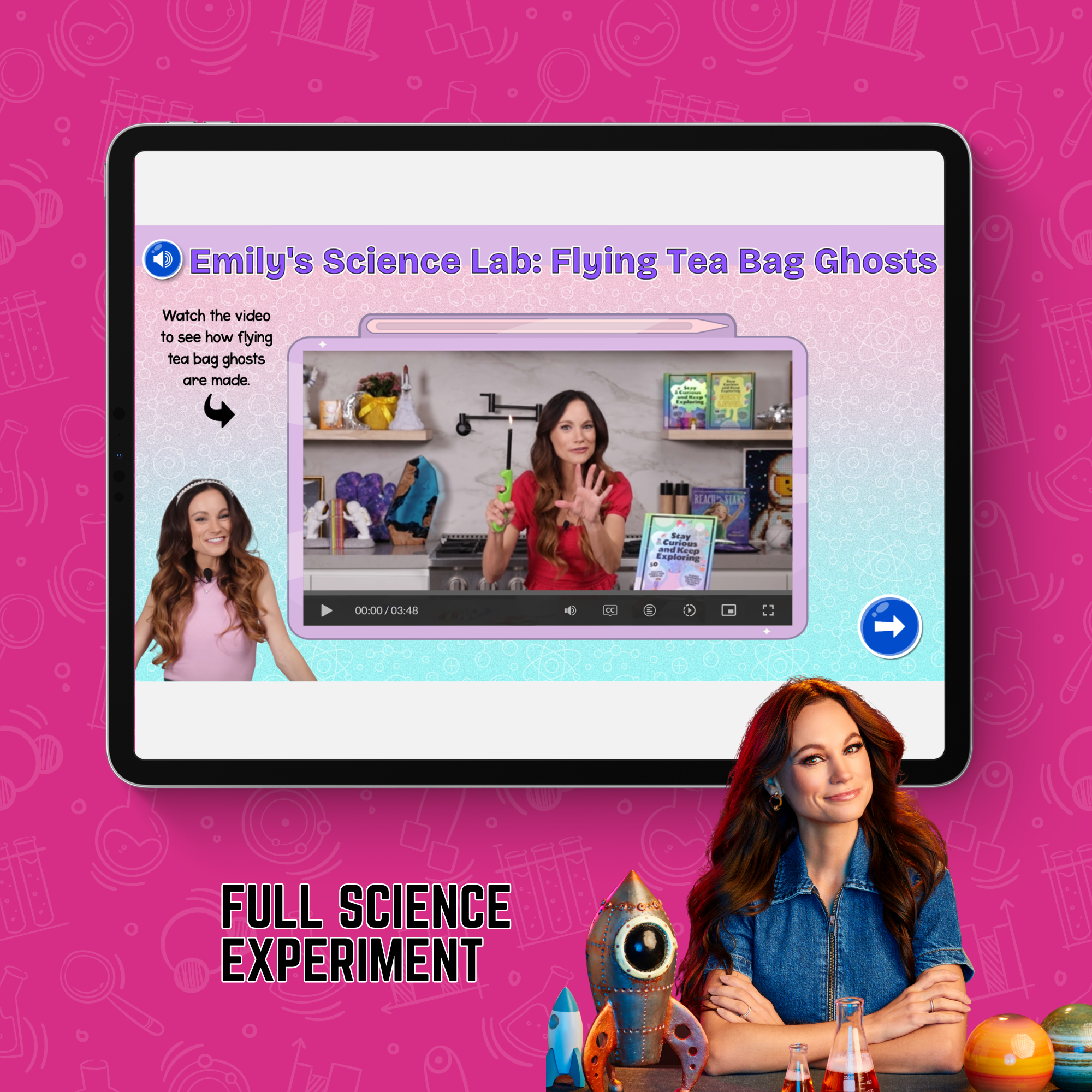
👻 Join Emily “The Space Gal” Calandrelli as she makes a tea bag ghost take flight while exploring air temperature, density, and convection. In this interactive digital STEM activity, 2nd, 3rd, 4th, and 5th grade students watch Emily’s Flying Tea Bag Ghosts experiment and investigate how rising warm air can lift lightweight tea bag ash.
No science unit required! ⭐ This activity is designed to stand on its own, so students do not need prior knowledge of density, air particles, or convection. Background information and science vocabulary help students understand and enjoy the investigation.
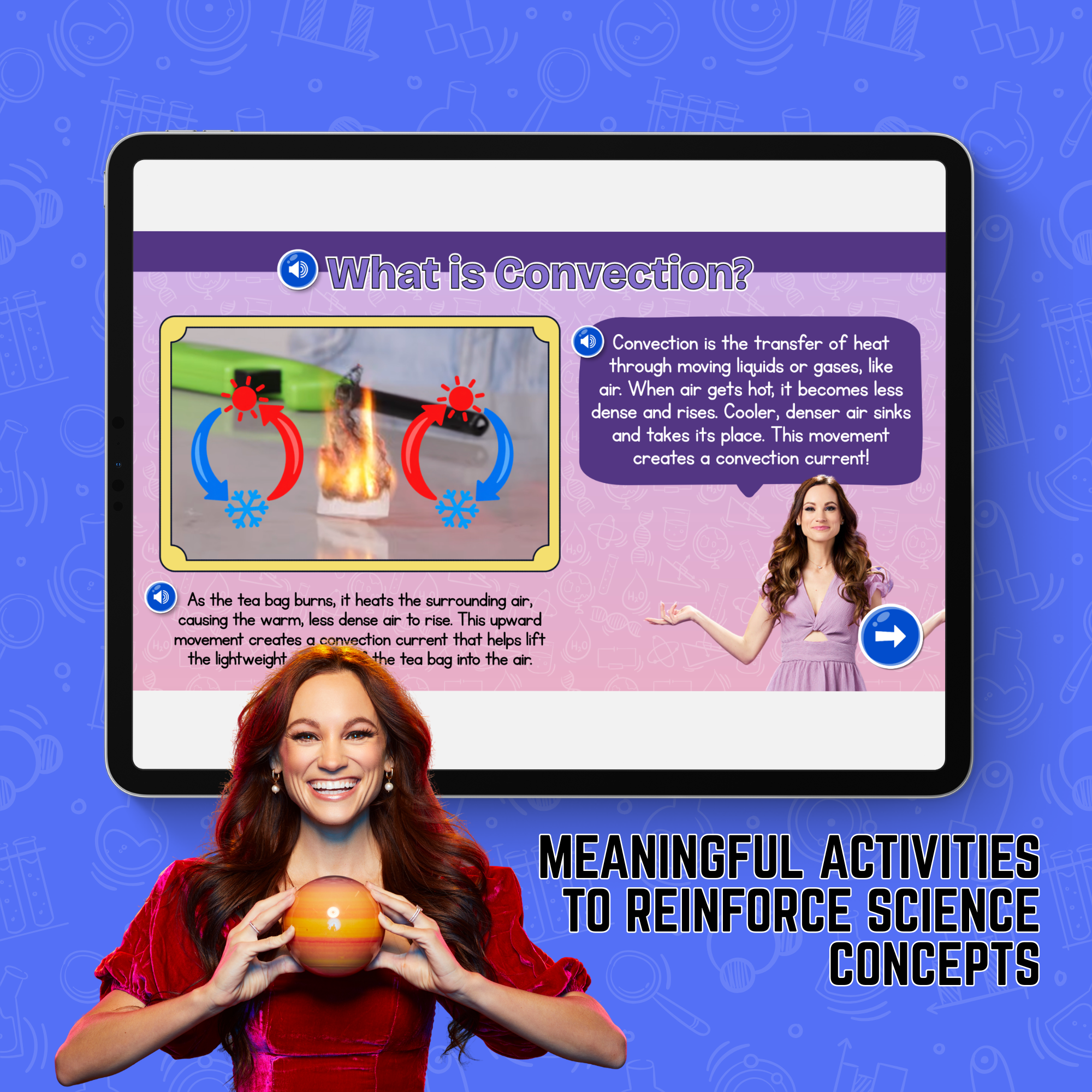
Big science concepts made simple. ✨ Clear, kid-friendly explanations help students explore how heating air changes the way its particles move—and why warmer air can rise through cooler air.
📢 This no-prep STEM activity is an easy way to bring an engaging science experiment into your classroom—even when you do not have the time, materials, or capacity to conduct experiments yourself! Students watch Emily’s demonstration and complete the digital activities without handling a flame or gathering experiment materials.
In this digital science activity, students will explore:
✅ How air particles move faster and spread farther apart when air is heated.
✅ How heating air can cause it to expand and become less dense.
✅ Why warmer, less dense air rises through cooler, denser air.
✅ How convection creates air movement that can lift lightweight materials.
✅ How the experiment connects to the way hot air balloons rise and descend.
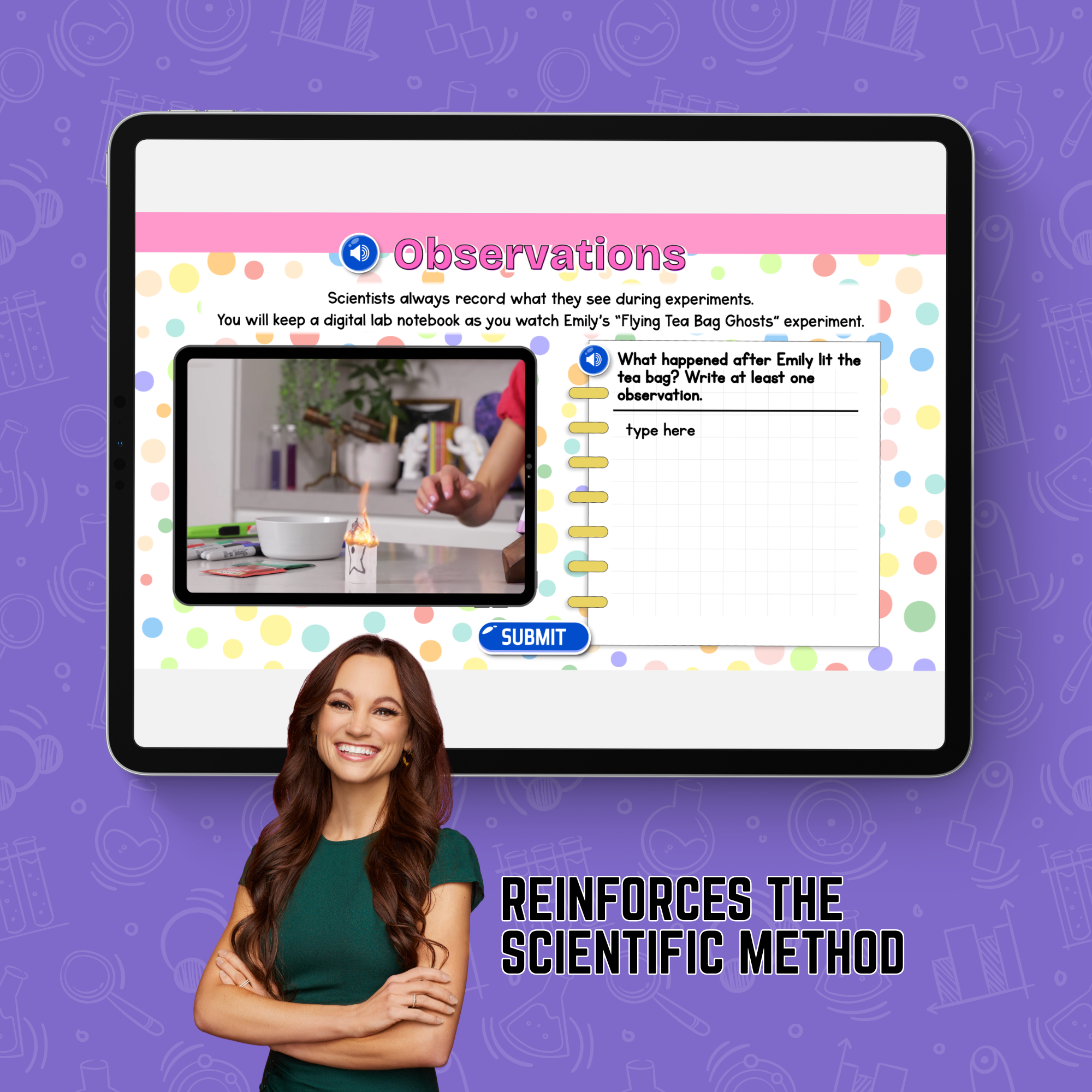
✅ How scientists make predictions, record observations, and explain results using evidence.
✅ How changing materials or variables could affect an experiment’s outcome.
Students begin with kid-friendly background information and science vocabulary before joining Emily for the Flying Tea Bag Ghosts experiment. They watch the tea bag burn and its lightweight remains lift into the air, then investigate the science behind the ghost’s flight.
Throughout the activity, digital observation responses, prediction questions, drag-and-drop activities, and interactive checks for understanding keep students actively involved. Students compare warm and cool air, explore changes in particle movement and spacing, and connect those changes to density and rising air.
Students also apply their learning to hot air balloon scenarios. They consider how heating the air or allowing hot air to escape affects a balloon’s movement and use what they learned to explain their choices.
After the experiment, students think like scientists and complete a quiz to show what they learned.
This activity provides elementary students with meaningful exposure to density, convection, and scientific investigation without requiring connection to a larger science unit. The goal is not for students to master the physics of flight or heat transfer. Instead, students use a surprising, high-interest experiment and interactive activities to build curiosity, practice scientific thinking, and begin to understand how changes in air temperature can cause movement.
Perfect for:
👻 Halloween or ghost-themed science activities
🌡️ Heat, air, and density investigations
🎈 Hot air balloon connections
🧪 STEM lessons or science enrichment
🔬 Scientific method practice
⭐ Fun Friday or special science activities
💻 Digital centers or independent learning
🚀 Gifted enrichment or extension activities
📚 Sub plans or low-prep science days
🏠 Homeschool science
✨ Anytime you want to add fun, meaningful science to your day!
This engaging resource makes it easy to provide elementary students with a colorful, memorable science experience through Emily Calandrelli and MagiCore.
✨ MagiCore WebLink Digital Resource – This science activity uses the power of MagiCore’s WebLink for an interactive browser-based experience that is easy to use and keeps students engaged and learning. Students click the link or snap the QR code to access the activity on their device. No prep. No copies. No logins. Once you try a MagiCore WebLink activity, you’ll never look at Google Slides the same way again. CLICK HERE to experience it for yourself!
About Emily ‘The SpaceGal’ Calandrelli
Emily Calandrelli is a science communicator, author, engineer, and space traveler who makes science exciting and accessible for kids. MagiCore is proud to partner with Emily Calandrelli to bring interactive science lessons, experiments, and activities to students everywhere. Through Emily’s Science Lab activities by MagiCore, students explore big science ideas in fun, engaging, and easy-to-understand ways that spark curiosity and deepen understanding. Emily’s passion for STEM inspires young learners to ask questions, think like scientists, and discover how science works in the world around them.
NOTE: This science activity is digital. It is NOT printable. The final screens include a summary of student responses and an option to view or print a completion certificate with the student’s name.
*Videos are not hosted on YouTube. This resource does not require YouTube access.
Key Features:
⚡ Immediate Student Feedback! Students will see if their answers are correct or incorrect for each question or activity.
What’s Included?
This activity is self-correcting and provides students with immediate feedback.
This resource is suitable for the following grade levels:
Time to Complete:
This science activity takes approximately 45 minutes to complete. The time it takes to complete can vary based on your students.
Only logged in customers who have purchased this product may leave a review.
Reviews
There are no reviews yet.